The intricate magic system in Weave the Lightning is revealed as characters use it. For a concrete break down, read on! (This contains world spoilers, but not plot spoilers.)
Intentionally creating new magic
Magical objects (imbuements) are created by imbuement mages during bozhskyeh storms. The mage first shapes their intent out of the emotional substance of a desperate need (a nuzhda) then calls down magical lightning (Gods’ Breath) to transform that intent into magic. If their nuzhda weaves are well-formed and matched to the object, the storm energy from Gods’ Breath travels through them, crystalizing their weaves and creating a stable magical object. A skillful imbuement can last years or even centuries, whereas a poorly constructed one could be a “one-shot”, used at the moment of its creation before leaving the object inert.
Using existing magic
Most people with a storm-affinity (the ability to sense/use magic) cannot create new imbuements, but can only activate existing ones. A trained storm mage (bozhk) is effectively the battery that powers an imbuement. They have to pull on the same type of desperate need (nuzhda) that was used in creating the imbuement, then “complete the circuit” by plugging their nuzhda into the imbuement’s connection points. This activates the imbuement so it can be used.
The strength of nuzhda used in activating the imbuement must equal the strength of nuzhda used in creating the imbuement (its nuzhda Category), which makes more powerful imbuements more difficult/dangerous to activate and use.
Some imbuements are so low-Category that they can be unconsciously activated by someone (even a mundane) experiencing a strong need (e.g., “darkbags” used to hide contraband, nuzhda bells used to test children for storm-affinities).
Types of nuzhda
Six types of pure nuzhda (plural, nuzhdi) exist, each glowing a distinctive color to the magical senses of someone with a storm-affinity. The type of nuzhda used in shaping an imbuement determines, in part, what the imbuement can do.
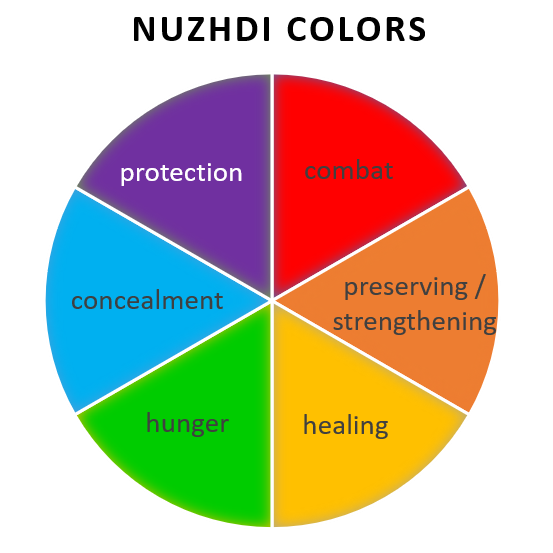
- Combat = red
- Protection = violet
- Strengthening / Preserving = orange
- Healing = yellow / gold
- Hunger = green
- Concealment = blue
Sousednia and pulling on nuzhdi
Sousednia is a realm of needs, ideas, and emotion, where magic is shaped. Someone with a strong enough storm-affinity (storm-blessed) can shift their focus into sousednia, experiencing it as a full, immersive reality. Typically, only storm-blessed mages can imbue new magic. Able to see sousednia, they have greater control over their nuzhdi and can learn to shape it into magical weaves.
If a storm-blessed mage is calm and grounded when focused on sousednia, they experience their core sousednia, the reality shaped by their personality and early life experiences. Powerful emotions bleed into a person’s sousednia, reshaping elements of it. An emotion powerful enough to form a nuzhda typically manifests as a fugue-state memory loop (nuzhda fugue), creating a nuzhda-warped sousednia.
To imbue new magic or activate an existing imbuement, a trained mage (bozhk) deliberately puts themself into a nuzhda fugue to “pull on the nuzhda.” If they have enough training and clarity of mind, they can then wall off the nuzhda, creating mental barriers that allow part of their mind to remain caught in the nuzhda fugue, while the rest of their mind returns to a calm, rational state, evidenced by experiencing their core sousednia.
People with a storm-affinity who cannot see sousednia (storm-touched) can still pull on and wall off nuzhdi, they just do not experience the full secondary reality of sousednia when doing so.
Imbuing (Safely)
To imbue deliberately and safely, a storm-blessed bozhk (aka imbuement mage or tvoortse) must be able to simultaneously hold three realities clear in their mind.
- A nuzhda-warped sousednia / nuzhda fugue: to generate the nuzhda they need to shape in order to create an imbuement (e.g., a combat fugue to imbue a magical gun; a healing fugue to imbue a magical bandage; a hunger fugue to imbue a sack of grain).
- Their core sousednia: keeps them grounded in their own identity and able to think rationally. Without this, the bozhskyeh storm’s raw magic will enflame the nuzhda’s desperate need, driving them to draw too much storm energy into themself, possibly trapping them forever in a nuzhda fugue (which will warp their behavior and experience of reality).
- True-life: keeps them grounded in reality. Without this, the storm energy from a bolt of Gods’ Breath can permanently shatter a mage’s connection to true-life, leaving them trapped in sousednia (storm mad).
The imbuement mage shapes their nuzhda weaves (the intent and purpose of the magical object) out of the emotional substance of their nuzhda fugue. E.g., the intent for “a knife that can cut through steel” is formed out of a combat nuzhda.
During a bozhskyeh storm, the imbuement mage will feel a storm-thread in sousednia, which grows from the base of their skull and connects them to the bozhskyeh storm. If the storm is close enough, they can pull on their storm-thread, drawing a bolt of Gods’ Breath down to strike them. If they match the strength of their pull to the strength of their nuzhda and its weaves, storm energy will course down through their storm-thread, into their body, and out into the object they intend to imbue. The storm energy will crystalize the nuzhda weaves inside the object, turning it from an idea into an actual magical object.
An imbuement mage can partner with a strazh mage (see below), to make imbuing safer.
Additional dangers of imbuing
If the imbuement mage pulls too hard on the storm, they can draw too much storm energy into themself, either overflowing or shattering their nuzhda weaves. Poorly constructed weaves can also shatter when being filled with storm energy. Unless the overflowed storm energy is siphoned off by a strazh mage, it will crystalize the imbuement mage’s own nuzhda inside their mind (nuzhda burn-in), trapping them in nuzhda fugue. If the weaves shatter when being filled, the storm energy that explodes out of them can affect nearby people as well as the imbuement mage, possibly causing nuzhda burn-in or nuzhda-warping those nearby.
Similarly, the purpose of a nuzhda, its weaves, and the object must match or the storm energy is more likely to shatter the weaves. E.g., if a mage tried to shape a healing imbuement out of a gun, the storm energy would not crystalize the healing nuzhda weaves in the gun, but would shatter them, instead crystalizing the mage’s healing-warped sousednia, locking them in a healing fugue.
Strazh mages (plural, strazhi)
Storm-touched bozhki (unable to see sousednia) can train as strazh mages to support imbuement mages, making imbuing safer. Strazhi learn to create a particular type of nuzhda weave that operates like a grounding line on a house. When a house is struck by lightning, a grounding line creates a path for the electricity to flow safely to ground, avoiding that electricity burning up the house. Similarly, a strazh mage creates a simple nuzhda weave that begins at the base of an imbuement mage’s skull (at their storm-thread), travels through the strazh mage’s body and into the ground.
If an imbuement mage overflows storm energy (by pulling too hard on the storm or making a mistake during imbuing), that overflowed energy will dump harmlessly through the strazh weaves into the ground instead of damaging the imbuement mage.
A strazh weave has two key components: at the interface with the imbuement mage, the weave must be built out of the same type of nuzhda as the imbuement mage is working with (e.g., if the imbuement mage is creating a healing imbuement, the strazh weaves at the imbuement mage’s neck must be formed out of a healing nuzhda). At the base of the strazh weave, where it plunges into the ground, it must be formed out of a protection nuzhda. The type of nuzhda transitions as it travels through the strazh mage. The smoother this transition, the less risk to the strazh mage.
If there’s an imperfect connection at any point, some storm energy will overflow either into the imbuement mage or the strazh, with the same risks described above.
Strazhi also train to help imbuement mages return to themselves if they experience any nuzhda burn-in or lose their hold on true-life. One method is pulling against the imbuement mage’s core nuzhda, effectively creating a lighthouse that the imbuement mage can use to return to themself. Unlike nuzhdi typically used in imbuing, a person’s core nuzhda is not pure, but a complex mixture of nuzhdi that represents who that person is when calm and grounded.
Imbuement size and complexity (Categories)
The complexity of an imbuement’s nuzhda weaves (the intent shaping the desperate need) determines the imbuement Category.
The size of nuzhda used in creating the imbuement determines its nuzhda Category.
Imbuement Category determines what an object can do. Nuzhda Category determines how difficult it is to activate (how powerful a nuzhda the bozhk must pull against to use it). Categories are exponential, so a Category Two imbuement is 10x more complex than Category One. Category Three is 10x more complex than Category Two, etc.
Storm-affinities: true-life and sousednia
True-life and sousednia are two distinct realities, which exist for every person. For each individual, how close those two realities are to each other is effectively measured by a person’s storm-affinity.
No storm-affinity (a mundane): their mind doesn’t touch sousednia. Under normal circumstances, they cannot sense, activate, or create magic. (Possible exceptions: during “minor miracles,” low-Category, group imbuements which may be created over hours, typically by singing religious Songs in a storm temple. Additionally, mundanes in desperate situations may spontaneously imbue during a bozhskyeh storm; these are known as “wild imbuements,” and are typically one-shots.)
Storm-touched (a bozhk, if they’re trained): their mind just barely touches sousednia. They can see the glow of an imbuement’s open connection points (because the magical object brings true-life and sousednia into contact at those points), enabling them to connect their own nuzhda into those points and activate the object’s magic.
Storm-blessed (an imbuement mage or tvoortse): their mind overlaps sousednia to a greater or lesser degree, which means they see bleed-through from this reality into true-life. They see people’s sousedni-shapes and the glow of active imbuements (in addition to their open connection points). They can shift focus into sousednia and experience it as a complete, sensorial reality. Storm-blessed mages can speak with other storm-blessed mages fully in sousednia, their conversation inaudible from true-life.
If a storm-blessed mage lose their true-life grounding while in sousednia, they can get stuck in this other reality, unable to find their way back to true-life. Children with strong storm-blessings may need special training to avoid accidentally slipping into or getting lost in sousednia.
Storm-mad: a person who’s lost their true-life grounding becomes storm mad. Sousednia completely overlaps true-life, making it impossible to distinguish one reality from the other. Worse, if the person is nuzhda-warped (e.g., from shattering an imbuement), sousednia reflects a skewed, desperation-twisted version of that need space (a nuzhda fugue).
Bozhskyeh storms enflame emotions
During a bozhskyeh storm, true-life and sousednia press closer. This has the effect of enflaming emotions, driving nuzhdi to become more powerful, and encouraging imbuements.
Genetics and storm energy
Contact with storm energy affects a person’s storm-affinity. Mundanes who create wild imbuements in desperate situations are likely to have a weak storm-affinity afterward. The children of people who imbue (and thereby handle storm energy) typically have stronger storm-affinities than their parents.
Bozhskyeh storm cycle
Magical lightning (Gods’ Breath), which carries storm energy, occurs only during bozhskyeh storms. In Bourshkanya, bozhskyeh storms are common during the active period of the storm cycle—roughly 50 years out of every 200. During the approximately 150 years of the storms’ off-cycle, it is not possible to create new magic.
Bookshop.org | B&N | Amazon
Audio: Audiobooks | Audible | Libro.fm
Rebellion. Magic. Romance.
It has been decades since magical storms have been seen in Bourshkanya’s skies. Their return should be Celka’s greatest moment—giving the resistance the weapons they need to overthrow the tyrannical Stormhawk—but after a lifetime of hiding her gift from the State, she’s had too little training. Hazy lessons from a father lost to the secret police aren’t enough, and calling down magical lightning with no clue how to control it is too reckless, even for her.
Gerrit, son of the Stormhawk, is unable to safely use his magic despite the State’s best training. Fleeing the Army, he stumbles upon high wire walker Celka in her travelling circus and senses the gift she’s hiding. Fearing capture, Celka ambushes him. She can’t trust an arrogant tool of the State, but his knowledge of magic begins to fill the holes in her education, while her easy intuition unlocks Gerrit’s own control.
As the resistance demands more from Celka and the secret police close in on Gerrit’s trail, the two must decide how much they’re willing to risk for their beliefs—and for each other.
 Corry L. Lee